Showing posts with label artists. Show all posts

Tuesday, May 1, 2012

Speaking with Clare McFarlane

For this month's Speaking with Clare McFarlane took some time to speak with bear among bees about her work, her formative experiences and future projects. You can currently see an exhibition of McFarlane's work at Turner Galleries (running till the 12 May) or find her work in a Laneway in Perth.

Sky’s chorus I, Clare McFarlane, 2012, acrylic and spray-paint on canvas, 100 x 100 cm

bear among bees: Can you tell us a little about your creative background?

Clare McFarlane: My mother always encouraged me to do art and be creative. I grew up on a farm in a small town and compared to many people I know now I had a rather culturally sparse experience growing up.  No art galleries, no public art - well I remember the high school kids did a mural in town once. There was just the art prize at the local show which was one day, once a year. My mother always encouraged me to take part in this. I remember you won 50c for a second prize and $1 for a first.

Luckily the school I went to had a specialised art teacher (unlike many primary schools) so I did get a lot out of art at school - I was also part of an extension program at the school and one part of that I remember (apart from computer programming and chess) was learning to paint with oils - this would have been maybe year 6 or 7. I really remember those classes and what I learnt then. My mother organised once a week out of school art classes for me with the art teacher. Just me and the teacher... but it was probably really good to have that one-on-one tutoring.

Anyway, I got into the special art program at Applecross SHS, which was wonderful really. Learnt a lot, had some great tutors, met other really talented individuals which was good for me - I'd always been the best at art at my school before but also one of only a few people with any interest in it, so it was great to meet others who were also interested. Though it did take a while to fit in - well... okay, I never really felt like I fit in but that was another story. It was my plan to do biology at uni but in year 12 I got a crush on one of my tutors and decided do art at Curtin (which is what he had done).

Spring’s lament i-ii, Clare McFarlane, 2012, acrylic and spray-paint on canvas, 70 x 100 cm

The year I started at Curtin had a very large percentage of mature age students - I mention this because I think being straight out of school actually benefited me because I was still in the "do what teacher tells you" mindset.  So while some other students, especially mature age ones, had issues with some of the more 'avant-garde' projects, I was quite happy to try new things.  Still I was probably a relatively 'conservative' student - majoring in painting and with a minor in printmaking in second year, then majoring and minoring in painting in third year - all the cool kids did sculpture back then :)

I went on to do Honours and then was part of the first group of students to do the newly created Masters of Creative Arts.  The research I did for that has had the most influence on all the work that followed...

bab: It sounds like your mum was instrumental in your becoming an artist, was she creative herself? 

CM: Well, apparently my mother always wanted one of her children to be an artist - this is what I've been told though I don't feel too pushed into that area.  But she wasn't particularly creative - she did photography and writing I suppose but she didn't come from a creative background, she was a teacher at the local school, teaching English, social studies and health.


Wishful Thinking i-ii, Clare McFarlane, 2010, acrylic and silkscreen on canvas, each 45 x 100 cm

bab: Also, I saw you did a Graduate Diploma in Cultural Heritage. Did that come before or after your Masters work? Did this play a big part in shaping your ideas on Australian identity and the historical references in your work?

CM: Ah yes, after doing Masters and discovering it qualified me to do retail I decided to do yet another degree. This time something that would get me a job. I already had romantic ideals about museums and history before I started the Grad Dip - kind of why I chose it instead of Library studies which I was also looking at.

During my Masters I became interested in the Pre-Raphaelites and I had an interest in history especially in terms of the feminine and sublime (honours) and the Victorian period - (by then my mother was studying and she ended up doing a PhD in women's journals from the 1830s).  And my interest in Australian identity came more from my interest in flora and fauna - it occurred to me at the time it was really 'not done' to use Australian flowers in contemporary art and that would be a bit of a challenge.

Also, at some point someone asked me about my use of Victorian patterns and what this said about Australian identity - so I thought that was interesting and continued to explore that.

The Grad dip in cultural heritage fed into the aesthetics of display in my work I think while also reinforcing ideas of Australian identity and other historical references.

Ideas of display and collecting I suppose actually - Cabinets of wonder, etc

A Murder’s verse ii, Clare McFarlane, 2011, acrylic and spray-paint on canvas, 70 x 70 cm

bab: I worked for a while at the State Library of WA in private archives so I'm always interested to see collections cross over into being art, rather than art being just a part of the static collection. Your recent work for the Fringe Festival as half of The Exit Stencilists duo definitely references that cabinet of curiosity tradition and museum display. Can you tell us more about this project & how it came about? And what role does collecting play in your individual practice?

CM: I actually worked in the Curtin Library for six years while doing post grads at uni - and I did think about becoming a Librarian at one point. :) I also have worked for the Holmes à Court Collection and the UWA collection.  I am very interested in 'collecting'.  Collecting plays a big part in my practice - apart from the references in my work, I have a collection of dead birds, insects and photos of birds and wildflowers, as well as other related matter (books, patterns etc).

I am a bit of a collector at heart so I collect many things - random and otherwise - and sometimes they may become relevant to my work and then sometimes not. I have a collection of tea cups but they have yet to be part of my practice ;)

As for 'Enter through the Window' - Leon Ewing and I decided while doing the work for City of Perth (he was my dogsbody for the project) to form The Exit Stencilists to try and get further art projects - the Fringe Festival exhibition kind of just happened - being part of Gotham Studios I was aware that we had nominated The Peekaboo Gallery as a space for the festival and I thought 'why not be a part of it your self?'.

Leon and I eventually came up with the rather self-indulgent idea of a kind of wunderkammer of changing displays which really suited the situation of the exhibition place - it is viewable to the public constantly and gets an awful lot of passing traffic, so the idea of a changing display gave it more meaning for those that would pass by many times during the length of the festival - and then a few days in we came up with the idea of actually adding to the display as opposed to changing it completely. Seemed so logical when you think about it - and both Leon and I basically got to show off some of our stuff. He is also a compulsive collector - and then we just went extreme at the end - seeing just how much stuff we could display within reason. Of course we documented it everyday - within the display with Polaroids so the passer by could see the evolution - as well as online.  We certainly enjoyed it and it would be good to be able to do it again and refine the idea...

bab: In my recent interview with Maria Hildrick she spoke of her collection of dead little creatures too, we touched on the overlooked history of these creatures, the “once was” life. Can you talk a little about what it is that attracts you to collecting the birds and insects? 

CM: Hmm... I suppose I find them very poetic - to me they really speak of loss - of death, of the briefness of life - fleeting joy of a bird’s life - of flight. But the other attraction is the tradition of the 'gentlemen scientist' of the Georgian and Victorian times. Quite a quaint idea but an idea of its time.

Lilt of the Firetail, Clare McFarlane, 2012, acrylic and silkscreen on canvas, 45 x 100 cm

bab: The Victorian aesthetic seems quite important in your work; can you tell us about that and the patterning you use which are also rooted in those times? Where do the patterns come from are they found patterns, or do you design them?

CM: Actually, I'd say my aesthetic was definitely more Japanese in nature, when you look at my positioning and composition. Japanese and Scandinavian design are where I would define a lot of my aesthetic. But yes, Victorian patterning is a very important element of my work - more precisely it started with Pre-Raphaelite design and the work of William Morris.

These were patterns designed in the romantic period - Victorian in England - and they came from very romantic ideals and ideas.  What interested me was their romanticism of nature as represented in these designs.  At the time (when I was doing my MCA, 98-99) I was looking for a credible way of representing the feminine and technology without reverting to images of sexualised robot women ah-la Metropolis.

The William Morris patterns were a beautiful vehicle for this - they were these networks of interconnected plants - nature redesigned to fit the Victorian aesthetic - they were like a background structure to which we culturally adhere, or a growing network or nodes, hardware, software, servers and information.  They were perfect for integrating the feminine and technology.

SO that was where it started but they have grown to be more - I have used them to talk about Australian identity, as well as the scientific inquiry of nature and the need for humans to classify and catalogue nature.  At the moment I am thinking about it in terms of history and memory - of layers of wallpaper ripped off revealing more underneath.

Most of the patterns I source from books - a lot are William Morris patterns while others are from the same/similar period - the mid to late 19th Century. Sometimes I may change them I bit but I'm not really interested in designing new patterns - I'm just interested in using old ones :)

Dragon’s verse i-iii, Clare McFarlane, 2010-12, acrylic and silkscreen on board, each 26 x 16 cm
bab: What’s coming up for the rest of 2012 for you? Any upcoming shows or special projects? 

CM: Well, there is of course my current exhibition at Turner (a murder's chorus + other winged verse) which has been rather all consuming.  I'm going to go in a few art awards - I am definitely going to try and do at least one more wall mural this year - should be able to get one in Subiaco I hope - been talking to Jenny Kerr but the one we organised got pulled by the building owner - he wanted to put advertising there instead.

I'd like to organise something in Melbourne some time soon and to visit there this year.  I was going to see how much work was left over from the Turner show to see if there was enough to form the basis of something for Melbourne. Or maybe somewhere else - I have not been as forward as I could be when it comes to trying for exhibitions outside Perth - I need to correct that.

bab: And where can people find out more about your work?

CM: Really the best place to find out more about my work is through the Turner Galleries website:
http://www.turnergalleries.com.au/artists/clare_mcfarlane.php

Saturday, April 14, 2012

Sandra Dieckmann Illustration

London based illustrator, Sandra Dieckmann draws enchanting images inspired by nature and wildlife, harmonised with beautiful folk style patterning. Bear among bees is so in love with her bear images (a few favorites posted below) but go check out Sandra's website to see a wonderful menagerie of animals, or visit her etsy shop where you will find a range of tote bags, prints and cards featuring her work.

Bear Rock, Sandra Diekmann

Beach Bear, Sandra Dieckmann

Sweet Dreams, Sandra Dieckmann

Tomorrow Bear, Sandra Dieckmann

Bear, Sandra Dieckmann


Sandra Dieckmann Illustration
http://www.etsy.com/shop/SandraDieckmann
http://www.sandradieckmann.com
http://sandradieckmann.blogspot.com

Monday, April 9, 2012

Speaking with Lance Kershaw Ladu

I was introduced to Lance Kershaw Ladu's work when interviewing Cherish Marrington last November. She pointed me to his Facebook profile where I found such intriguingly beautiful ink drawings, I had to find out more and Lance kindly agreed to this little interview with Bear among bees.


untitled, Lance Kershaw Ladu, ink on paper.


I have to confess I am pretty new to your work and have only seen your drawings online but I’m really loving what I have seen. Can you tell me about the characters in your drawings, are they based on people you know, or are they fictional? And where do your characters come from? 

Well, I have to say; these characters are based on myself I suppose. I try to embody my own feelings and emotions into these drawings, depicting myself mainly as women.

Your work seems to have a baroque or renaissance feel that kind of makes me think of Peter Greenaway, do you like his movies? Have you seen his drawings? And on the subject of filmmakers, there any movies that have significantly influenced your work? 

I adore film. I love Peter Greenaway’s films, like The Cook, The Thief, His Wife and Her Lover, though I have never really seen his drawings before, till you have mentioned their existence. But I must say they are quite exquisite. I am heavily inspired by films, such as The Hours, Mommy Dearest, The Others and many more, but my main focus of inspiration comes from psychotic, sad, depressed, cruel, disappointed women or mothers, which became quite evident in a small web design about myself clearly depicted. But I find an immense beauty in these raw emotions, which I think are intensified through women.


untitled, Lance Kershaw Ladu, ink on paper.


Who are some of your favourite artists? 

I guess I don’t really have a favourite artist. But I adore the works of Cherish Marrington, Gustav Klimt, Egon Schiele, John William Waterhouse, Andrew Nicholls and Tane Andrews.

I saw on Facebook some beautiful works in progress for an artist book you were making. Is that complete now? Can you tell me about it? 

The book called H is for Hippophagy, was a small, 18 paged, book that looked at a different perspective of hippophagy, which is the practice of eating horseflesh. It questioned ‘What is eating the flesh?’ which in my book was the natural decay of a dead carcass. The book was complete, but with my carless handling I managed to shamefully smudge most of the drawings. So it has now been dispersed and adored, hopefully, by their owners.


death [page insert 12 (pg 24/ pg.25) from H is for...HIPPOPHAGY],
Lance Kershaw Ladu, ink on paper.


Is your work mostly drawing, or do you work in other media? 

My work is strictly Ink. I find myself in the terrible position of loving this one medium, this one effect, that my own confounding comfort has scared me from progressing to other mediums. I suppose a love for traditional print techniques and drawing keeps me held to its exquisite bosom. Though, there are secret plans of a doll exhibition, which may lead to some spectacular birth of a new art practice for myself.

What would be your earliest creative memory? 

My earliest creative memory is when I was 6 or something and I drew the study of a woman. Women have played a big role in my life.

Are you working on anything at the moment that you can tell us about? 

I’m planning a show with one of my greatest friends Cherish Marrington, hopefully to be exhibited at Paper Mountain.


untitled, Lance Kershaw Ladu, ink on paper.


How can people find out more about your work? 

At the moment, I can’t be found anywhere. Hopefully soon I shall gain access to oniemy. But, I am easily found on Facebook, having the only name Lance Kershaw Ladu. So if someone is interested in finding me, find me there and stay informed. (Polite smile)

Saturday, March 3, 2012

Speaking with Maria Hildrick

The first time I met Maria was at an exhibition opening at The Oats Factory. I got talking to this rad lass and when I realised who she was I got a little excited, blurting something like, "oh my god your Maria Hildrick! I love your work" in a gushing way I seem to be prone to upon meeting people I've been admiring. Luckily for me she's good humoured and didn't run away. Instead we became friends and exhibited together last year in Beast for Thee. For March Speaking with she has graciously spent some time talking to me about her work.

Eileen felt her own absence, Maria Hildrick, 2010. Oil, graphite and ink on canvas.


Can you tell us a little about your background? Where did you grow up and where did you study?

I grew up mostly in and around Dublin, Ireland, spending a couple of years in England too. We moved a lot when I was little, I'd been to about 20 schools and lived in 30 different homes by the time I was 13. Moving home so frequently instilled my love of objects and the values we place on them. Also, pretty much all of our belongings came from second hand shops and this brought about a fascination with the history of objects, from op shops or the side of the street. Both my parents were very creative people so my sisters and I grew up surrounded by imagination, music and play. Painting and drawing have been a part of my life for as long as I can remember and it was one of the things I most enjoyed as a kid.

My Mum Eileen developed schizophrenia when I was about 7 and this intensified and softened in varying amounts until her death 10 years later. Witnessing and reacting to these times, as part of my family and as an individual, is another aspect of my history that imparts heavily on my work.

 I didn't sit the whole of my Leaving Cert (exams at the end of high school), only attending the Art and the English exam as these were the ones that I felt were important to me! I wasn't sure what I wanted to do with my self at that time really... I did a portfolio preparation course for a year and was lucky as the following year art colleges weren't only accepting students with enough Leaving Cert points anymore. They now accepted the cert I received from the portfolio course for entry to the college, along with a portfolio.

I started a degree in fine art at The National College of Art & Design in 2002. In the first year you got to play with everything before choosing what area you wished to specialise in. I did consider print, and enjoyed sculpture too but in the end decided on painting. The creative energy and location were amazing and really stimulating. There was a real emphasis on learning how to look, developing an awareness of ideas and how your work can be interpreted. I almost didn't realise how much I was learning and developing. I can really see the evolution of my current style from those years, particularly from the final two years, where my mixing of graphite, ink and oil began... I graduated in 2006 with a BA Fine Art, Painting and had my first solo show the following year. A few months later I left Ireland to travel and eventually found my way here to Perth.

Sandgroper enjoys feather, Maria Hildrick, 2010.

Do you think that the move to Perth, it's landscape (physical and/or cultural) have influenced your work in any ways that are particular to being here, in this place, at this time? 

The physical landscape has certainly influenced me. It really is vastly different to where I come from; the colours, the trees and plants, the wildlife, the light, the earth. I derive so much from nature and my surroundings that it couldn’t but permeate my work. Insects in particular have featured, at home too, but now to an even greater extent. In Ireland I used to work at a grain intake during the summer holidays and with the samples of barley would come the body of a earwig or a moth’s wing. Ladybirds caught by the combine mid flight were particularly treasured. The creatures I find here in Australia amaze me. I get very excited when I find a sand-groper who’s time has come or a stink bug who’s bitten the big one. One of the best is a praying mantis I found squished in Coral Bay.

There is an area of bush across from my house and it’s full of kookaburras, owls and magpies. Bobtail lizards too, who like to hang out in our garden sometimes. There is so much green space in Perth, so much wild life in the suburbs, that to be here now means a great deal to me as the city is growing so much. The bush land in front of my house has been sold and they are going to develop it into something like 50 apartments...

Also, coming to Perth and being so far away from everything I knew led me to explore objects in a different light. The verge side collection has been a great source of material for me and most of our house is furnished off the side of the street. My house-mates came home one day with a box full of carefully packaged ornaments; a ceramic cat, a little koala. These found objects, obviously once loved as they were remarkably well wrapped just to be chucked out, came to feature in much of my early work here in Australia. In the paintings they are searching for a place amongst imagery from my past. It wasn't until later that I realised this echoed how I too was searching for a place for myself. These pieces, once strangers and with their own history, have now come to mean a great deal to me. They are symbols of this place and that time. The other day I dropped the box they live in and let out a wail of devastation as I heard the sound of shattering from within! Fortunately none of the ones I use in my work were broken. It’s funny though, how the attachment develops. Coming here with just a backpack meant I was sort of starting from scratch in regards to objects with meaning and history. I now have a collection of objects that carry as much memory for me as the bench or the willow pattern plates from home.

Are you working on something at the moment that you can tell us about? 

At the moment I’m trying to figure out what I think about the form of an echo! I’m going to be doing a project with a WA arts magazine called dot dot dash and they are going to pair me up with a writer to collaborate on a piece. The brief is entitled the form of an echo and takes a passage from a talk by Derrida where he explores the story of Echo and Narcissus. I haven’t met my writer yet so at the moment I’m just spending time trying to figure out what I think and find a way into the subject matter, figure out my own thoughts...

Fish funeral II, Maria Hildrick, watercolour on paper.


Coming back to your use of insects and found objects, I can relate well to your attraction to these things and have used them in my own work. For me the "used" holds a kind of life via transference. Like as though along with our fingerprints, we leave bits of energy behind. And the little empty bodies of insects and small creatures make me think about what we overlook, little receptacles of “once was”. Do you have any thoughts on this and what attracts you to the found? 

I feel the same way, the insects are fragments of being, some are whole, some broken. Others have been hollowed from the inside out so all that’s left is their shell. They certainly carry the notion of “once was”, similar in a way to found objects and the history they carry.

I have collected a couple of bobtails too that were squished and dried out in the sun so just their skin is left preserved, their little legs caught mid run. I also found a small kangaroo paw and forearm recently. It was funny, initially I didn’t keep the paw, the leap to mammals seemed too great! I ended up going back for it the next day though… There is something about the bobtails in particular that resonates with being overlooked for me. I often see them on the side of the road. When they’re run over all their insides come out of their mouth because their skins are so tough. Their mouths are wide open, all the life rushing out of them… I guess they are such an every day thing for most people here that they don’t really register...

There are objects all over the world at this stage that I have lost or left behind. It’s interesting to me to think of these things and wonder where they are existing now, are they alone or part of someone else’s life. One of the things I love so much about the found is how it comes into your life, that you’ve happened upon this object because you went down that road, it’s that chance meeting. It’s kind of like that with people too sometimes.

The idea of leaving a type of fingerprint behind is lovely, makes me think of when I was little; my parents let us draw on the walls of the flats we lived in and when we moved on Johnny would repaint them. Under layers of paint in flats all over Dublin and London are little creatures and castles and lines and circles covered by more and more layers as other people lived there and moved on.

Wasp - 3D ink drawing, Maria Hildrick, 2010. Paper mache, wire, ink & plastic.
I love that idea of drawing on the walls of a home, another artist I interviewed last year, Lorraine Corker has a similar childhood story of drawing and writing on walls before covering it with fresh wallpaper. I've moved alot myself and find the idea of leaving a mark like this fascinating because I've never been able to feel connected to a "home" as such. Bricks and mortar seem so temporary to me and I suppose I like the fact that this drawing on the walls kind of celebrates an ephemeral notion of home. 

The sense of home is so subjective. I was at a exhibition last year, photographers were paired up with young homeless people to help them capture their notion of home on film. It was such a moving exhibit, images of stairwells and car parks, derelict houses and bushes; all these places, so out of sync with the mainstream notion of home, were home for these people. There was one girl who was no longer homeless and she took photos of the little porcelain creatures she collects. Just being able to have somewhere to put an object meant a tremendous amount to her and so the objects themselves came to carry that significance too...

Stereotypy I (Eileen), Maria Hildrick, 2011. Oil and graphite on canvas. 


Are there any books or movies that have significantly influenced your work?

What comes to the forefront of my mind is Jan Švankmajer’s Alice, a reworking of Alice in Wonderland, in which he explores the darker aspects of the story using a mixture of live action and stop motion animation.  Švankmajer uses bird, reptile and amphibian skeletons, stuffed animals and tongues, eyeballs and various organs to create the characters Alice interacts with. I first saw this as a child and was absorbed by it’s eerie, nightmarish qualities and particularly the use of animal parts, something that has permeated my own work as an adult.

Honesty in work is something I value, laying yourself bare. Hunter S Thompson's writing is influential for his raw and uncompromising accounts of experience, as is Charles Bukowski. It’s not so much a direct influence on actual paintings as it is on the integrity of my work I guess... I’m always honest to the times and emotions I draw on for my paintings. I rarely deviate from the original image and leave exposed my own personal experiences of transience, mental illness, suicide, love...

Where can people find out more about your work? 

People can find out more about my work and dates of upcoming shows at www.mariahildrick.com. We will be adding a mailing list soon too so keep your eyes peeled!

Wednesday, February 15, 2012

Speaking with Denise Brown

Can you tell us a bit about your background, where you grew up and where you studied art?

I grew up in Hawkesbury Upton, the highest village in the Cotswold Hills in South-West England, rich in Roman and Saxon settlements. Not much further afield are areas known for their ancient “land art”; the White Horse, Stonehenge, Avebury Stone Circle and Silbury Hill amongst many others. It is old country and a place bearing the layered histories of a long series of peoples.

Growing up in these surroundings, you become aware of the tides of change which constantly wash over human societies with the passage of time and the influx of new cultures. Living amongst such evidence of change brings home the importance of adaptability to the ever-changing “now”. It has led me to be flexible in my use of styles and media to suit my current concept.

My family were artisans and something of “outsiders” and so I was taught from an early age to be honest and to always strive to achieve one’s best because self belief is vitally important when society as a whole regards you with suspicion. The small, self contained world of the minority has little room for passengers. One needs to be both self-sufficient and beyond suspicion to achieve acceptance beyond the grudging.

I first studied art at Bristol Polytechnic, moving on to achieve a BA (Hons) in Three Dimensional Design, Wood, Metal, Ceramics and Glass at The Metropolitan University of Manchester. My experience during my course at Manchester has been fundamental to my understanding of materials and their properties and potential, leading to a broad ability to bring together apparently contradictory media such as the 3D pieces from my Emotional Tides series made from hand carved marble and fabricated steel.

Following my Degree my art practice evolved into working as a goldsmith during the evenings whilst earning a steady income as a patternmaker in industry. This industrial experience has been invaluable in enabling me to work on numerous projects and concepts simultaneously and to stringent deadlines.

Some years after migrating to Western Australia I enrolled in the Advanced Diploma in Applied Environmental Art and Design at the then Swan TAFE, graduating in 2009. During the course I was privileged to be mentored by such established artists as Peter Dailey, Stuart Elliot, Mary Dunin and others. Both my 2D work and my conceptual skills developed extensively during this period, as a result of the many positive influences.

Tell us a little about the kind of work you make?

I tend to work in series and multiples, conceptually built from my interest in the human psyche; the way we mentally interact with each other and the world around us; our ability to manipulate what our senses receive into information more palatable to our own ideas and logic centres, no matter how far stretched from reality that it may become.

I like to work on multiple concepts simultaneously. I try to achieve a spread of projects with at least one under way which has been fully developed conceptually, requiring only the physical manifestation of the works, balancing this with others where I am not fully in control of the outcomes, letting the concept lead me where it will. Others may spend years or even decades in gestation at a conceptual stage, requiring repeated reformulation. These tend to develop in quantum leaps, usually when I am engaged in other works of a repetitive nature allowing my mind to wander in sometimes unfamiliar territory.

You seem to work in a range of mediums, what is your favourite? And are there any you haven’t tried yet that you would like to?

Emotional Tides, Denise Brown.
My work is not usually about a specific medium and so I don’t have a favourite as such. Having said that, I was recently invited into a show where the concept did derive from the medium and found that working in this way was just as enthralling as my usual approach of picking the medium to fit the concept. It forced me to step out of my comfort zone and pushed me in new directions.

I do have favourite techniques however. I do like to carve. I find the act of carving in any medium relaxing and mediative. I also like to work on a medium to large scale because it is a physically more holistic experience and one can lose oneself in the action of making.

I also thoroughly enjoy the interaction needed to successfully work in oils; the ability to manipulate and play with the material and the variety of application techniques that one can develop. The whole experience is very tactile. Even the smell is intoxicating.

What are you working on at the moment?

I tend to work on half a dozen series at a time which all feed off each other in one way or another, this also allows me to change between mediums and keep interested and focused.

At the moment I am developing several bodies of work. One is all sculptural series for a solo exhibition in July this year at the Heathcote Museum & Gallery in Melville. The concept explores my early experiences as a dyslexic in a world that did not, at the time, widely recognise or acknowledge the condition, and examines the “outsideness” arising from the inability to communicate, whether as a result of a physiological condition (a lack of specific synaptic development) or that arising from cultural and linguistic differences within a migrant society such as Australia.

I am also working on a series of large paintings in oil depicting the figure and representing that figure’s personal history and psychology through the surrounding imagery. I see these works as being a development of portraiture but on a deeper emotional level than mere superficial likeness.

In addition, there is a series of ceramic sculptures concerned with the need for the primitive in the technical age and its manifestations and a further series of sculptures and oil and drawing works concerned with the mind in a state of coma.

Soft Power, Denise Brown.
I love the title Soft Power, can you tell us about the concepts behind that body of work?

The title Soft Power derives from my continuing amazement at the species of soft fungi that happily force their way through the road surface or even through concrete. There is also a fascination, in a similar vein, that water and time and tree roots can dismantle mountains, let alone the strongest man-made structures. Discovering these phenomena was like watching bumble-bees fly when I was a child, an act that seems to be totally contradictory to physical reality. I used the phrase soft-power to describe these subtle but immensely powerful forces to myself. In more recent times I discovered that Soft Power had become a political catchphrase to describe the diplomatic approach to foreign affairs as used by, for example, the Obama administration in dealings with the Middle East, in contrast to the militaristic “solutions” practiced by former leaders that had clearly not worked.

The works in my Soft Power series are designed to evoke contemplation of the potential of soft and slow but persistent and patient force.

You are a superb craftsperson, I’m always in awe at your attention to detail; even the backs of your work are beautiful! And you often hand-craft things that are normally mass manufactured like the dice pieces and custom made boxes to hold your work when it is not being displayed. What is the importance of the handmade to you?

I have pondered this question myself and I think it’s because the core of my work is concerned with either an individual or group of individual minds, so subconsciously I feel that each component needs to be unique in its own small way. Otherwise the essence of the works becomes mechanical and not organic as it should be.

I’ve noticed dice or dice like patterns appear in a lot of your work, what is the significance of these?

To me all life starts and ends with chance. There is so many more possibilities that don’t converge than the one that does, in every moment of every day, that I find the chance or probability of anything ‘being’ intoxicating. Many years ago I read a novel called ‘The Dice Man’ by Luke Rinehart, in which the protagonist gradually delegates more and more responsibility for his decisions to the throw of a die. The idea of someone leading their life by the results of chance, at the time, seemed crazy but it got me thinking about all the chances we take in life without narrowing the probabilities down to just six.

The die itself appeared in my work after a momentous chance decision that I and a friend made. We discussed possible outcomes but we both individually took the same chance and got very different life altering outcomes. This has inspired multiple works depicting dice which will eventually become a series called Die-Sect.

We were talking in your studio recently about the marble and steel sculpture series, Emotional Tides, you told me it was important when you made them that the steel cubes were hollow, even though it wasn’t completely obvious to the viewer. I thought this was interesting because at the time I had imagined they were hollow, perhaps because some appear to be bobbing on the waves. Others are on stilts and I keep thinking of them as little one room houses trying to keep above the water. Those forms also appear in paintings – can you tell me about them and why are they hollow?

The series of paintings, sculptures and drawing that you refer to came directly from personal interaction with a couple of different people. It was only once I had completed half the works that I realized the images were coming from my childhood through my subconscious reaction to recently passed dialogues.

When I was a very young child my mother worked on the land with others of my family and myself and my cousins would spend time in safe areas near them. These areas were often small wooded circles in the centres of large patchworks of ploughed fields, where we kids were safe from the tractors and other farm machinery working nearby. Later, as a teenager, I would play in the local woods and fields with my friends and in the centre of these fields were circles of woods that during the summer months contained the crow-scaring guns. These areas, we were taught, were very dangerous and to be kept well clear of, so we did just that. It wasn’t until I was painting the images in my head that I realized that the safe areas and the crow gun islands were one and the same.

So in answer to your question the stilted boxes represent these islands of safety and danger. They need to be hollow in my mind so that they can perform their roles as protector or predator.

Do you have any current or upcoming shows?

Yes, I am exhibiting at the moment in the joint show with Gallery East and Midland Junction Art Centre called, ‘Between the Sheets’.

I will also have works in a collaborative show between visual artist and text artists, the art/text/clearinghouse project by Perdita Philips and showing at the Perth Centre for Photography, opening on the 9th of February.

I have been invited into an exhibition by Kate Parker, at Mundaring Arts Centre in April, which is based around the idea of location and how it manifests in ones work.

My fourth solo exhibition will be held in July this year at the Heathcote Museum & Gallery in Melville.

How can people find out more about your work?

Directly via my e-mail at denisevbrown[at]bigpond.com or through Mundaring Arts Centre, Artsource or Facebook.

If all goes to plan I am intending to have my own website by the end of this year.

Tuesday, January 31, 2012

Speaking with Naomi Hunter

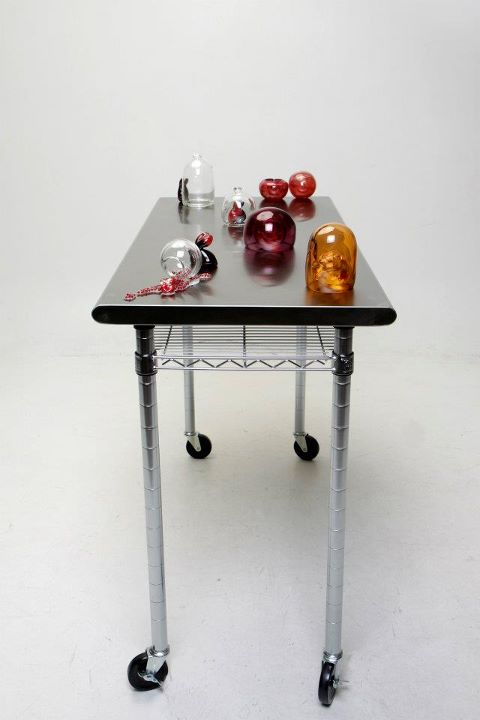
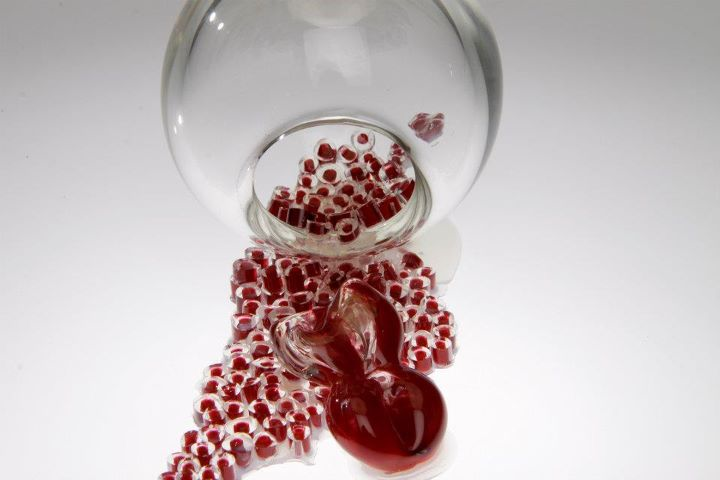
I was introduced to Naomi Hunter's work by her solo exhibition, Skin: an imperfect coat November last year at The Oats Factory. What I saw was sensuously visceral glass forms and vessels that used the naturally fluid nature of the medium to convey various states of being. I was lucky enough to catch up with Naomi for an interview before she heads over to Adelaide to complete her PhD.

Specimen Table, Naomi Hunter.
Photographer: Paul Godfrey
 
 
Your installation of glass vessels and organ-like forms spread across the stainless steel medical/kitchen benches had quite a strong emotional effect on me. It made me think of the vulnerability of the body and submission to procedure or examination. Am I on the right track? Can you talk further about this installation and the other works in the show? 

I have always been interested in the dualistic nature of the relationship between the immaterial mind and the material body. How thoughts affect the physical body and the body molds thoughts. Is the body a mere vessel for consciousness and how can I reveal the normally unseen internal collaborations?

My work is an ongoing exploration of the space between the immaterial and material self –– mind/body, and the space between the mind/body and the world. Making visible the constant negotiation of perceptions around the body in the world and the idealised self. My installation works are experiential which means it is based on the knowledge gained or idea imparted through the experience the viewer has when entering the exhibition space.

Specimen #14 (detail), Naomi Hunter. Blown and hot sculpted glass.
Photographer: Paul Godfrey
 
In entering the space the viewer becomes immersed within the work not merely viewing from the outside. To that end the use of the stainless steel benches allowed tension between the organic glass and the seemingly ‘perfect’ shining steel, to be revealed whilst including the reflection of the viewer within the work. In using components within the installation that range from the abstract to the figurative and the play on the notion of ‘the vessel’ encourages the viewer to explore their own ideas around the work.

Specimen # 15, Naomi Hunter.
Blown vessels, hot cast and steam-
sticked.
Photographer: Paul Godfrey
 
The image here shows two objects made of the same components, made one after the other following the same process. Yet they both have reacted to the process in different ways. Glass can be suspended between states of liquidity and solidity, its symbolism oscillating between endurance and fragility – traits often related to the human condition.

Have you always worked in glass? And what first attracted you to this medium?

I have always had a creative streak and worked with a variety of mediums mostly textiles and found objects but it wasn’t until I went back to Uni to do an Arts Management degree that I saw the possibility of being the artist. Whilst doing an elective in visual art I wandered in to the glass studio to see David Hay and Jasper Dowding making glass pieces for Kevin Gordon and I was hooked...couldn’t drag myself away. The constant movement of the liquid and the ongoing interaction between the artist and the medium held me fascinated. Also the contrast between its robust malleable liquid form and the fragility of the final piece resonated with me.

I transferred over to the Visual Arts course and the rest is as they say history.

Who are some of your creative influences? 

Australian Glass artist Gabriella Bisetto has a number of processes and themes that resonate with me – her often seemingly simplistic forms are technically challenging to perfect, whilst capturing the notions of recording the bodies process such as Little breaths.

I would have to say that my influences are almost as eclectic as my work. I am drawn to the paintings and drawings of Gustav Klimt. His representation of the body, show it in not only its beauty but at the same time awkward. As well as sculptor and installation artist Anish Kapoor with his highly reflective polished surfaces and grand scale.

I saw from your FB profile you studied at Alberta College of Art and Design in Canada and are currently living in Perth, WA. It sounds like you have done some moving. Can you tell me about that and how these places have shaped your outlook? 

Once I had decided to study visual arts I realised that my fascination with glass was getting stronger. I felt to be able to use the medium in an cohesive way I needed to have hands on experience of the different processes. So in 2007 I did a 12-month student exchange at Alberta College of Art and Design, which had a hands-on training degree in glass blowing. Living in a cold climate after growing up in Perth was a shock. I had seen and experienced cold and snow in short bursts whilst on holiday but to negotiate on a daily basis was a new experience.

And you are moving East soon? I think I remember you telling me when we first met that this was for further arts study? Can you tell us a little about this and what you will be working on? 

Specimen # 1. Spill, Naomi Hunter. Blown and sculpted glass, Murrini and resin.
Photographer: Paul Godfrey

I am moving to Adelaide to complete my PhD in Visual Arts. Adelaide has a strong glass movement with an Undergraduate degree in Glass at University of South Australia and the glass workshops at the Jam factory.

Where can people find out more about your work? 

One of my projects once I’m settled in Adelaide is to work on a web page. At the moment people can contact me directly via naomihunter[at]iinet.net.au

Saturday, January 21, 2012

Last night I dreamed I was dreaming of you...

Last Wednesday I made a Facebook status update, "Last night I dreamed I was dreaming of you...".

The line is from a Tom Waits song, "Watch Her Disappear". That single line has been whirling about my mind, in that way that songs occasionally haunt you with some past truth you couldn't properly articulate.

On Friday, my friend and brilliant artist behind Doublethink Design, Chiara Adams posted on my Facebook wall that she had created an artwork (below) based on my status update. I don't know whether she was familiar with the origin of the line but I was blown away by how eloquently she had expressed it. Like that strange uncanny feeling I was having had just been given it's full voice. Thankyou so much Chiara.

Last night I dreamed I was dreaming of you, Chiara Adams. Graphite and watercolour. 2011.
Go find out more and follow Chiara Adam's fantastic work at these links:
Doublethink Design
on Facebook
on Twitter
on Tumblr

Tom Waits - Watch Her Disappear

Saturday, November 12, 2011

Speaking with Cherish Marrington

Intraspecific Competition, Cherish Marrington,
ink on paper, 2011.

Can you tell us a bit about the kind of work you make?

Most of all I like to draw, and specifically make drawings of characters that oftentimes alarm or puzzle even myself. I tend to invent the personality first, and afterwards, the character. Sometimes they are reflections on people that I have seen or met before, otherwise they are totally imaginary. All the while I question their existence, and as I am drawing, I think about their lives. They are definitely real people—only, I have corrupted them in my own manner.  

Who are the characters in your work?

Some of them are not my friends, and are the kind of people that are only nice when they want something. The way I form a character is similar to the methods of traditional animation. I am willing to redraw the same character many times until it has been moulded to my specifications, until I understand this character’s way of thinking, or simply until I have the line work just so. Concerning lines and textures, I can be quite pedantic and in this manner I can also relate to Chinese painting: the importance of mark making and how each manner of mark has its definitive place in an image. A certain line can be a specific expression all on its own—that sort of thing.  

I really like the photographs of your people out and about among the grass. Do you leave them for people to discover, or do they come home with you after a photo shoot?

I don’t generally litter, although leaving them for people to discover is quite a romantic idea. This was simply one of those explorations that began on a whim—I like to play with scale a lot, and to have the viewer question the time and place of something like this. The imagery captured of these little paper dolls getting lost in the grass led to other things and ultimately I made drawings that related to all of this along the way.  

This Is Ralph, Cherish Marrington
ink on paper, 2010

How did the animated film Sassy Playmates come about? I really enjoyed them dancing about the familiar urban landscapes of Perth, and I was creeped out too… with a smile, great combination!

An important person to mention is an artist named Matthew Moore. Certainly, working with this dynamic personality is an enriching life experience. When I discovered that he knew a thing or two about animation I immediately felt compelled to not let these useful skills go to waste. We share the same sort of sense of humour and planning an animation was as amusing as building it together. This, combined with the music he programmed made a piece that instantly worked for us, and we plan to have more of it this coming year.  

Can you talk about oniemy.org? It seems there has been a few collaborations among the artists, Sassy Playmates being one example and Slave Trade another, also there appears to be a fair bit of exhibiting together. How did oniemy come about, and does being a part of this collective have an influence on your individual work?

Again, I can only speak highly of my cohort, Matthew Moore. Back when we were both studying art simultaneously last year, it came to our attention that our fellow hungry art students needed to get their brilliant work online and we wanted to set up a neat little online space for our favourite Perth-based art minions. As far as collaborations go it is mainly Matthew Moore and I, but there is nothing like doing group shows a few times a year with our friends. I think that there are some good things to come, as we have studios now! Paper Mountain—get excited.  

No One Knows What I am Doing, Cherish Marrington
ink on paper, 2011.

Who or what are your biggest influences?

I’m very attracted to the work of Istvan Banyai, Giovanni Battista—his etchings from Piranesi—and the work of such animators as Sylvain Chomet and René Laloux (especially his Fantastic planet).  

What is your earliest creative memory?

Probably as far back as yesterday, and the day before. Everything else gets outdated and vague quite rapidly.  

What are you working on at the moment?

I’m planning a show with my favourites: Erin Tily-Laurie, Lance Kershaw Ladu and Matthew Moore. I am wild about their work.  

How can people find out more about your work?

I would say do some Googling to find out what’s new—it’s easy to do since there aren’t many other Cherish Marringtons out there. Well, maybe there are but they don’t generally have my name.

Sunday, November 6, 2011

Thoughts on Skin: an imperfect coat

Skin, it is that thin line that separates inside from out. Even perhaps, a separation from what is myself from what is not. The functions and processes going on beneath our skin are hidden from view, and rarely thought about day to day. Despite this, the smooth functioning of those organs protected within are what enable us to be. In fact, it is not until we are faced with illness that we become acutely aware of the vulnerability of what's hidden beneath this protective membrane.

Installation view, Skin: an imperfect coat, Naomi Hunter.
Image via The Oats Factory.


Last Friday night I went to the opening of Perth based glass artist, Naomi Hunter's exhibition Skin: an imperfect coat at The Oats Factory. Hunter combines glass, steel, installation and film to form a three part exhibition. In the front part of the gallery is an installation which brings to my mind the clinical examination of the body - under bright light vessels spill red droplets like blood onto stainless steel surfaces, glass organ-like forms sit beneath specimen containers, and some seem to teeter dangerously close to the edge emphasising their vulnerability. This acts for me, like a manifestation of the loss of control felt when faced with illness. When we place our trust in medicine and submit to procedures that can be frightening and humiliating. Yet, like the body and all its imperfection these glass forms Hunter has created are intriguingly beautiful.

Sam (detail), Naomi Hunter, glass, steel and light.
Image via The Oats Factory.

The second part of the gallery is like a transition into an earlier stage of life. It contains larger sculptural works in a darkened space which have an ethereal quality to them. These works incorporate perforated steel with glass ovum-like centers. The glass, a membrane protecting the light emanating from within.
In the third part we step back another stage. An up close moving image of glass while Hunter works with it is projected onto the wall. Like promordium this liquid is evolving into form, ever changing and ever in process.
Skin: an imperfect coat runs until the 27th November at The Oats Factory, 69 Oats Street, Carlisle WA, Wed – Sun 12 - 5pm.

Friday, September 23, 2011

Speaking with Laura Mitchell

The Elephant of Eastbury: The Book, Laura Mitchell
Acrylic and Mixed Media on canvas.
via laura-mitchell.com.au

Can you tell us a little about your background?
 
I grew up in a hick town in Virginia, USA and quickly moved to the nearest most cosmopolitan city I could find (Washington DC) as soon as I could! I studied music and English Literature in university since I had a very unpleasant and negative drawing professor early on, but my passion for visual art won out later when I realised I hated playing in orchestras. I returned for a MFA in design where for my my MFA thesis exhibition, I staged a fine art rather than design oriented multimedia installation based on exploration of a multi-tracked narrative. I had formerly made several artists books instead of presenting visual diaries for various critiques during the coursework. This was the beginning of my passion for the depiction of “narratives”, stories, or as we say in the design industry “type and image”. After a career as an art director/graphic designer in the dot com boom, I moved to Perth and decided to redirect my energies into fine art which was my original love. I have a diploma from Central TAFE where I studied sculpture have completed a few semesters of painting at ECU and Curtin.

I saw your exhibition The Elephant of Eastbury at Kidogo Gallery in Fremantle earlier this year for which you had worked collaboratively with poet, Andrew Gates. You also produced a lovely publication of the same name with the fullpoem text and 10 colour images. How did this collaboration come about? 
 
The poet, Andrew Gates of Connecticut in the US was accepted by Littlefox Press to publish his work. The publisher, Christine Matthieu of Littlefox Press in Melbourne, then approached me to do the project as a commission. I had done illustration work for them formerly, and they knew of my passion for fine art based upon texts or stories. Christine then connected me with the poet in the US.

The Elephant of Eastbury: All and Nothing, Laura Mitchell.
Acrylic on canvas. Image courtesy of the artist.

I'm very interested in the combination of poetry with visual imagery, it can be quite a hard thing to balance two peoples versions of a narrative and I think Elephant does this very successfully. Were there any moments when you didn't agree with each other on how something should be interpreted? Were you in conversation together throughout the creative process, or did one of you create work for the other to respond to?

The poet and the editor had already finalised the poem, so I didn't have any influence on the text. There was quite a bit of collaboration regarding the images, however. I first started working on the images from the concept of “childhood memories” - the elephant being a symbol for memory – and the result was a series of still lifes with an elephant. The publisher then felt that there needed to be at least one image more concretely related to the text “the elephant wandering between the ears”which spurred the series of tiny elephants within an abstract background with the outline of an ear. These I was very pleased with. The other was a landscape with elephant and outline of a person's head, which I felt was too “graphic” and a bit forced, but it satisfied the gap the publisher was feeling between the words and the images. Later, I was looking for more inspiration and asked the poet if there was anything more behind the poem, and he told me a very inspiring story (based on reality) of a young child going next door to find his grandmother lying motionless, beside her a tiny bejewelled elephant which was no longer there when he returned having fetched his mother. This then inspired my exploration of death as a journey: the map, airplane, trunk, and glasses left on open book images were a result of this.

Who are some of your creative influences?

I love Kara Walker, with her incredibly powerful “storybook” cut-out images based on the politics and personal history of women and minorities. I also enjoy the work of Sally Smart and wonder how much influence she took from Walker. Another favourite is LA based “low brow” artist Camille Rose Garcia with her abstract backgrounds and pop culture inspired foreground figures, one series of which supported endangered species. My mentor during the Elephant project was Melbourne artist now relocated to Perth Jo Darvall, whose extremely meticulous approach to colour and her extremely fine hewn approach to mark making is inspiring.

The Elephant of Eastbury: Origins of Meaning, Laura Mitchell
Acrylic and mixed media on canvas. Image courtesy of the artist.

You are also a professional musician, what do you play? And does playing music inform your visual work, and visa versa or are they very separate processes? 
 
I play violin mandolin and sing a bit, but have enlisted 2 great singers to help me with the latter! Our group is called TrioAlegra & the Velvettes and consists of violin, mandolin, accordion, double bass, percussion and of course 3 part vocal harmonies. I have also done session work for various musicians. I used to have a second band on the go but that got canned when my second child came along! More time for that later. My music I would say is a parallel but separate process. For instance the idea of “consonance vs dissonance” in music I can relate directly to visual elements such as line, texture, colour. Harmony and melody and counterpoint I relate to lines and compositional elements, and “timbre” in music I relate to texture in visual art. Pitch I suppose for me could be related to tonality (light & dark) or level of saturation. So in this elemental or conceptual way each process informs the other, but in terms of “representing” aural phenomena directly, no I have attempted that and found it too difficult! I do however love Kandinsky who I believe sometimes worked in that fashion.

Do you listen to anything when you are painting? If so, what?

I frequently listen to nothing but to the sounds around my studio. John Cage was one of the innovators in the concept of simple random sounds, or even silence itself, as music. Because music for me is often “work” I cherish silence. Sometimes I feel obligated to interrupt my art practice to work on music which can be a dangerous form of procrastination – not dedicating enough focus to either the art or the music but getting caught dabbling in both! However having said that I love Bach, Dub, drum and bass, world music, tom waits, old-time/bluegrass, Balkan brass bands... jazz jazz and more jazz and sometimes put my ipod on random while working with all of this rotating.

You have lived in quite a few different places around the world but you are now based in Perth. Have these changes in place had a great influence on you creatively? And what do you like about where you live now?

I have displaced myself with migration many times in my life and have thrived on the challenge of absorbing and attempting to assimilate into a new culture or place and the different energy and stimulation each new place has brought me. However I am extremely grateful to be based in Australia, WA in particular as the fantastic quality and style of life has afforded me the option to pursue fine art and music as an independent agent. In the US I lacked confidence of leaving the “job” as health care is exorbitant without an employer, there are no viable free health care options there. When I first moved to Perth I didn't find it particularly creatively stimulating in and of itself, but I found the space, not just in the landscape but in

The Elephant of Eastbury: Edge of an Ear,
Clockwise from Top Left: Bone, Earth, Blood & Water
Laura Mitchell. Acrylic and mixed media on canvas.
Image courtesy of the artist.

What's coming up for the rest of 2011 and into 2012?
The Elephant of Eastbury Book will tour to the US in late 2012 to be presented in 29 Main St. Gallery at Virginia Commonwealth University in Richmond VA, and on May 11, 2012 I will be participating in a group exhibition on the concept of “Time” at the Moores Building in Fremantle. My works will be developed through a collaboration with another poet, William Yeoman (also Arts Writer/Books Editor for The West). Following the theme of time, he has written 12 poems following the concept of the “Horologos” - a set of 12 poems based on each hour of the day (and night), each with a connection also to a season.

Where can people find out more about your artwork and music? 
 
Thanks so much, Claire. My artwork can be viewed on my website, more recent works can be seen via email or studio visit, simply contact me, details below. To hear about concerts and exhibitions please go to the contact section of my website and sign your email in through the form and I will send notices.
+61 435 054 122 | +61 08 9336 2646